

Nikola Tesla once stood before the Niagara Falls Commission with a problem that nobody could solve.
Edison’s landmark system at Pearl Street Station in lower Manhattan utilized direct current, and couldn’t travel more than about 100 yards before it lost so much power that it wasn’t worth sending.
So, his answer was to create alternating current. However, AC alone wasn’t the invention — the piece of equipment that made AC actually usable was something most people couldn’t identify today if you put one in their driveway.
He built what we know today as the transformer.
First step voltage up for the long haul, then throttle it back down before it reaches a light bulb… it’s as simple as that. That’s the invention that let Westinghouse’s Adams Power Plant send electricity 20 miles to Buffalo in November of 1896.
It also happens to be the same basic technology sitting inside every substation in America right now.
In fact, the transformer house at Niagara is still standing today, preserved as a National Historic Landmark.
Now fast-forward 130 years to today, and that same unglamorous box just became the single biggest thing standing between America and the largest infrastructure buildout in its history.
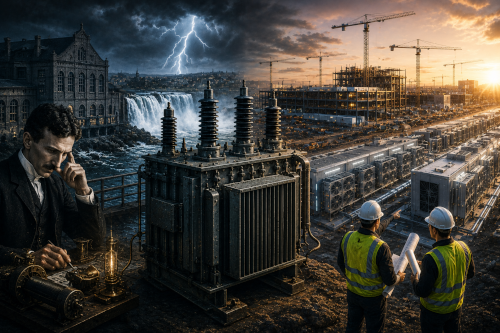
OpenAI’s $500 Billion Project Is Sitting In An Empty Field
OpenAI’s $500 billion Stargate project in Texas has reportedly sat as an empty field for months with no meaningful physical progress on-site.
Believe me, the money was there.
The problem is that the equipment wasn’t.
In the past, you could ship a large power transformer in about 30 months. Today, those lead times run up to 5 years. Switchgear — the stuff that actually connects a transformer to the grid safely — is sold out through 2028.
The Best Free Investment You’ll Ever Make
Our analysts have traveled the world over, dedicated to finding the best and most profitable investments in the global energy markets. All you have to do to join our Energy and Capital investment community is sign up for the daily newsletter below.
You’re not getting it faster no matter how much you’re willing to pay.
This year alone, roughly 16 gigawatts of data center capacity has been announced, yet only about 5 gigawatts of it is actually under construction.
For the record, that’s less than a third of what’s been promised in media headlines that’s actually breaking ground. And current estimates put up to half of this year’s $750 billion in AI data center spending at risk of delay or outright cancellation.
Again, we’re not looking at a funding problem.
The issue comes down to parts.
But there’s a catch in all of this…
You see, the U.S. manufactures only about 20% of the power transformers it actually needs. The rest comes from overseas, with China as the single largest producer of the electrical equipment underneath this entire buildout.
What that means is that tariffs and trade friction now sit directly in the critical path of every data center in America.
Meanwhile, the existing fleet is falling apart from old age.
Remember, more than 55% of transformers in service today inside the U.S. are over 33 years old. Some analysts model a 30% national shortfall in large power transformers, with distribution transformers running roughly 10% short on top of that.
You and I both know you can’t build a transformer factory in a year. The specialty steel, the copper windings, the skilled labor to hand-wind these things — none of it scales on a press release’s timeline.
And you can bet this isn’t a temporary supply-chain hiccup like what happened in 2021.
Wall Street is missing a the fact that it doesn’t matter which energy source wins the AI power race.
We’re talking about gas turbines, restarted nuclear plants, geothermal wells — every single electron still has to pass through a transformer before it reaches a server rack.
And that market is effectively controlled by three companies: Hitachi Energy, Siemens Energy, and GE Vernova.
So, the smart money’s already made its move.
Some of you might remember back in February when GE Vernova closed a $5.3 billion deal to buy out the remaining half of Prolec GE (its transformer joint venture of 30 years) giving it full ownership of a business it previously had to split with its Mexican partner.
Look, you don’t make that kind of big move for a market you expect to shrink.
Separately, Siemens Energy committed a billion to expand grid and turbine manufacturing on U.S. soil — that’s a check you don’t write casually.
Clearly, both companies understand exactly where the bottleneck is and exactly how long it persists.
Tesla solved the distance problem in 1896 so power could travel further than anyone thought possible.
Today, distance never really was the problem: Supply is!
And that’s precisely the kind of quiet, unglamorous infrastructure bottleneck that gate-keeps the entire AI buildout, long before Wall Street figured out to look past the power plants themselves.
A century later, we’re finding out the hard way that we still can’t live without it.
We just forgot how hard it is to build more of them.
Until next time,

Keith Kohl
 Check us out on YouTube!
A true insider in the technology and energy markets, Keith’s research has helped everyday investors capitalize from the rapid adoption of new technology trends and energy transitions. Keith connects with hundreds of thousands of readers as the Managing Editor of Energy & Capital, as well as the investment director of Angel Publishing’s Energy Investor and Technology and Opportunity.
For nearly two decades, Keith has been providing in-depth coverage of the hottest investment trends before they go mainstream — from the shale oil and gas boom in the United States to the red-hot EV revolution currently underway. Keith and his readers have banked hundreds of winning trades on the 5G rollout and on key advancements in robotics and AI technology.
Keith’s keen trading acumen and investment research also extend all the way into the complex biotech sector, where he and his readers take advantage of the newest and most groundbreaking medical therapies being developed by nearly 1,000 biotech companies. His network includes hundreds of experts, from M.D.s and Ph.D.s to lab scientists grinding out the latest medical technology and treatments. You can join his vast investment community and target the most profitable biotech stocks in Keith’s Topline Trader advisory newsletter.
P.S. Do You Know What PK-10 Is?
Everyone is focused on chips and data centers, but the real obstacle to AI’s future may be something much simpler: the wires connecting it all. A breakthrough material called PK-10 could replace decades-old copper technology with a faster, cooler, and far more efficient alternative — and one little-known company has spent years preparing for the shift.


